


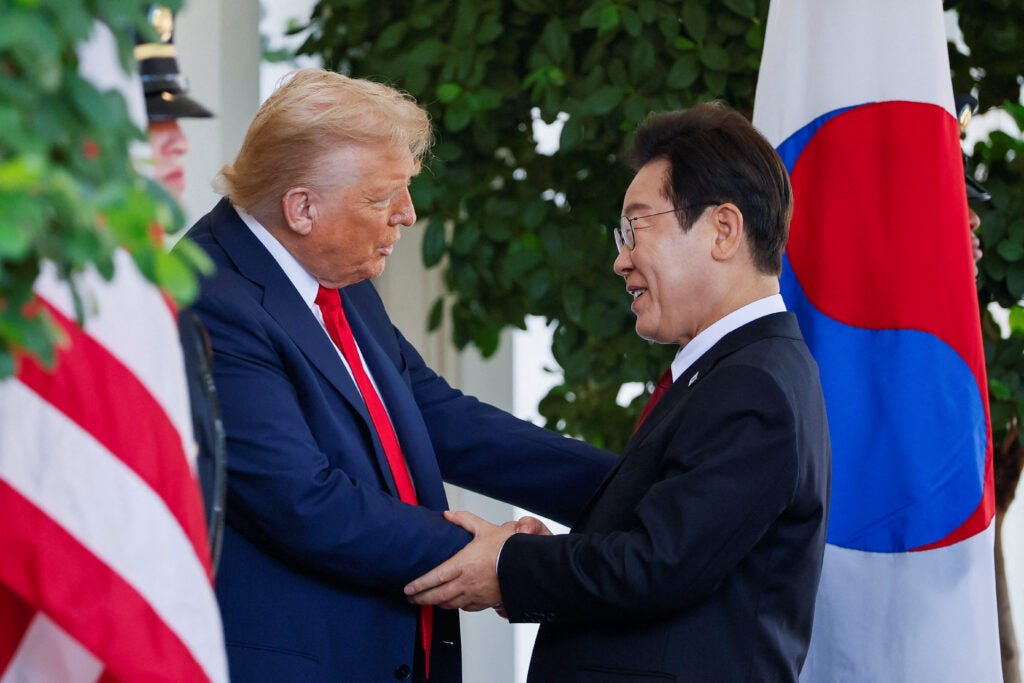
The long-term strong alliance between the U.S. and Korea, which has been badly shaken over the past 18 months, was dealt a strong blow by the President’s recent announcement that he had ordered the Pentagon to “substantially reduce” joint military exercises with South Korea - citing cost and, more strikingly, his “very good relationship” with North Korean leader Kim Jong Un. He added that Seoul had failed to support his unprovoked confrontation with Iran. The following day he posted a friendly photo with Kim and said the two “get along GREAT.” Trump claimed Kim treats him with “respect,” while he scolded Seoul over unmet investment commitments. Once again, this episode signals to allies and adversaries alike that U.S. security commitments are flexible, changeable on a whim and personality-driven.
This comes atop a year of tariff whiplash, a landmark but fragile investment pact from Seoul and an unprecedented wave of Korean corporate capital flowing into U.S. chip and car plants. The question is not whether South Korea will formally break with Washington - it will likely not - but how much of the economic good will and strategic capital built over seven decades is being quietly eroded, and toward what alternative arrangements Seoul, and the region, might drift.
The Underlying Economic Relationship
South Korea is the sixth-largest U.S. trading partner. In 2024 the U.S. imported roughly $132 billion in Korean goods - dominated by autos and auto parts (over $45 billion), semiconductors, electronics, and machinery - while exporting about $65 billion to Korea. This trade relationship is underpinned since 2012 by the landmark Korea-U.S. Free Trade Agreement (KORUS). Korea’s economy is unusually trade-dependent, with exports and imports together accounting for roughly 85% of its GDP, which makes Seoul disproportionately exposed to any disruption in U.S. market access or investment flows.
Since Trump 2.0, the relationship has been overlaid, by a separate bilateral “bargain”: a July 2025 “framework” deal under which Korea committed to pour roughly $350 billion into U.S.-directed investment—$150 billion earmarked for shipbuilding—plus $100 billion in U.S. energy purchases, in exchange for a capped 15% tariff rather than the 25% rate Trump had threatened. That structure sits uneasily alongside KORUS, which technically still governs the bulk of tariff-free trade between the two countries; Seoul has in effect layered a politically negotiated investment-for-tariff-relief on top of a two-decade-old rules-based free trade agreement, without either side clarifying how the two now are supposed to interact.
The Tariff Rollercoaster: Where Things Stand
The tariff track record with Korea in 2025 alone illustrates why Seoul has struggled to cope with the U.S. bipolar behavior. Washington’s initial “Liberation Day” tariffs placed Korea at a 25% rate. Then a July deal brought that down to 15% in exchange for the investment pledge. In January 2026, frustrated that Korea’s legislature had not yet ratified the implementing legislation, Trump announced he was reinstating the 25% rate on autos, lumber, pharmaceuticals and other goods - triggering a Seoul Stock Exchange selloff.
Then the U.S. Supreme Court struck down the tariffs Trump had imposed under emergency powers. Not to be thwarted, the administration then turned to a rapid pivot to alternative tariffs under a hodgepodge of other legal authorities. It all means that Korean exporters currently face a multi-track, overlapping, confused tariff architecture rather than a single predictable rate. And a concern they could change once again at the drop of a hat.
So while KORUS remains in force, its practical relevance has been subordinated to a series of executive-driven tariff actions and an investment-for-access “ransom” that Korean officials themselves describe as still being implemented on a project-by-project basis.
Hyundai’s Bet on America
Hyundai Motor Group’s response to tariff pressure has been to localize production at a scale with few parallels among foreign automakers. In 2025 the company pledged $21 billion in U.S. investment through 2028 - later expanded to $26 billion - covering a $12.6 billion EV and battery “Metaplant” near Savannah, Georgia (expanding capacity toward 500,000 vehicles annually), a roughly $6 billion steel mill in Louisiana to supply Georgia and Alabama plants, and additional spending on autonomous driving, robotics, and AI partnerships. Combined with its existing Alabama and Kia’s Georgia plants, Hyundai aims to build about 1.2 million vehicles annually on U.S. soil—supporting more than 570,000 American jobs.
That bet was explicitly transactional: Trump told Hyundai executives that domestic production would exempt the company from auto tariffs, and the White House used the announcement to argue that “tariffs work.” Yet Hyundai’s stock still fell sharply each time Trump threatened new tariff hikes - including the January 2026 25% threat - underscoring that even massive on-shoring commitments can’t insulate Korean firms from policy shocks, and that the goodwill purchased by such investments can evaporate with a single social media post. A 2025 immigration raid on a Hyundai battery plant site in Georgia, in which more than 300 Korean workers were detained, added another wound that Korean officials have not forgotten, even as Hyundai executives continually publicly reaffirm their commitment to U.S. expansion to satisfy a tetchy president.
Chipmakers: Straddling Two Capitals
Chipmakers Samsung Electronics and SK Hynix face a starker balancing act. Samsung is completing a $37 billion advanced logic fab in Taylor, Texas, and SK Hynix is investing roughly $15 billion in Indiana for AI memory packaging - commitments made in part to secure access to the U.S. market and to CHIPS Act incentives. But both companies are simultaneously the anchor of a much larger, government-backed effort to build a new semiconductor cluster inside Korea itself: a roughly $520 billion southwestern “chip belt”, with some reports suggesting the two firms’ combined 10-year capital plans could approach $1.3 trillion. Trump then floated tariffs of up to 100% on memory chipmakers that fail to build capacity in the U.S., a threat widely read as aimed at Samsung and SK Hynix specifically; it has since been shelved but not withdrawn, leaving it as a standing source of leverage - and mistrust.
Still, the two firms have also cleverly moved to bind themselves more tightly to U.S. demand rather than U.S. soil: just last month, Samsung and SK Hynix unveiled roughly $950 billion in long-term memory-supply partnerships with American AI developers - SK Hynix supplying an estimated $750 billion in chips to Nvidia and others, while Samsung committed $200 billion to Broadcom - announced during President Lee Jae-myung’s San Francisco AI summit alongside Nvidia, OpenAI, Anthropic, and Broadcom executives. That interdependence is a genuine economic asset for both countries: American AI infrastructure is now substantially underwritten by Korean memory production, and Korean officials estimate 80–90% of the demand behind their planned chip expansion originates with U.S. customers. Yet this can also be a vulnerability. If Washington concludes Korea is directing its best capacity and its most advanced nodes toward its own southwestern cluster rather than U.S. fabs, the excess-capacity investigation and the shelved 100% tariff threat gives the administration ready tools at hand to escalate, precisely at a moment when trust in Washington’s predictability is already strained.
What is Now at Risk
Investment discipline and timelines. Korean finance officials have already signaled that portions of the $350 billion pledge may slip because of the weakness of the Won, and the slow process of selecting U.S. projects - contrasting unfavorably in Washington with Japan’s more rapid rollout of its own investment commitments. A security relationship perceived as transactional and personality-driven gives Seoul less domestic political cover to defend big-ticket U.S. investments against critics who argue Korea is not getting equal security reassurance in return.
No tariff predictability. With KORUS’s tariff architecture now effectively supplanted by a discretionary, frequently renegotiated bilateral deal, and with Section 301, 232, and 338 trade actions layered on top, Korean exporters and their U.S. suppliers face a live risk of rate changes on short notice, complicating multi-year capital commitments for firms like Hyundai and the chipmakers.
Extended deterrence credibility. Scaling back Freedom Shield exercises while publicly courting Kim Jong Un - paired with Trump’s earlier redeployment of assets toward the Middle East - sends a signal, as Senator Jack Reed and other national security analysts have argued, that Washington values Gulf security over Northeast Asian security. That perception, more than the drills themselves, is the strategic damage: this belief is difficult to reverse with a single reassuring statement. At the end of the day, Asian allies are left exposed without appropriate naval assets in place.
Washington’s own leverage. Every dollar of Korean investment that flows instead into Korea’s domestic semiconductor belt, into Vietnam, or into the EU is a dollar of leverage the U.S. does not have the next time it wants Seoul’s cooperation - on export controls toward China, on Taiwan, or on Indo-Pacific coordination more broadly.
How This Could Reconfigure Asia
Beyond dollars on the table, the regional security stakes are extremely high. Kim Jong Un enters any renewed dialogue in a far stronger position than in 2019: North Korea has deepened military and economic cooperation with Russia, including reported troop deployments of over 50,000 in support of Moscow’s war in Ukraine, expanded ties with China, and advancing its nuclear and missile programs. Analysts agree Kim’s price for any new engagement with Trump will be de facto acceptance of Pyongyang as a nuclear state. This would come at Seoul’s expense. The irony is that Washington is trying to force Tehran into giving up its nuclear ambitions at the same time it is turning a blind eye to Seoul’s northern neighbor.
For Seoul, the lesson of the past several years is that U.S. commitments carry uncertain shelf lives. That lesson is legible in Tokyo, Taipei, and Manila as well.
The poor treatment of Seoul (and other allies) has consequences: continued acceleration of Korea’s own chip self-sufficiency drive; deeper trade and tech engagement with the EU and Southeast Asia to reduce reliance on the U.S.; reconsideration of independent or shared nuclear deterrent options; and a Korean foreign policy establishment that hedges more actively towards Beijing on issues where it once deferred reflexively to the U.S. None of this implies Seoul is abandoning the alliance outright - Korean strategic interests remains deeply invested in the U.S. relationship, and no viable domestic political coalition currently favors a full pivot away from Washington. But an alliance sustained by inertia and asset lock-in (American troops, integrated military command structures, billions in sunk Korean capital in U.S. factories) is a different scenario than one sustained by confidence, trust and reciprocity, and the erosion of the latter raises the odds that the next crisis - a North Korean provocation, a Taiwan contingency, a global shock - finds the alliance less cohesive than Washington has banked on.
Washington’s Cost
None of the individual episodes — the tariff back-and-forth, the excess-capacity investigation, the reduced military exercises, the Kim Jong Un “bro-mance” is by itself decisive. Korean funds continue to flow into American factories in massive sums and Korean chips continue to power U.S. AI infrastructure; both governments have strong structural incentives to keep this going. But the risk is cumulative and reputational, rather than outright rupture: each unilateral slap, each public snub, and each unreciprocated overture to Pyongyang chips away at the predictability and trust that make South Korea willing to keep placing outsized bets on Washington and keep subordinating its own strategic autonomy to Washington’s judgment. The question is not whether South Korea will formally exit the alliance, but how much Seoul - and other allies watching closely - will begin questioning every future American utterance and commitment, and what that will cost the U.S. the next time it needs Asia’s most capable and most reliable partner to move in lockstep.
*Debra Marks is a Strategic Advisor at ALI